
Good outdoor speakers should make music feel present where people gather without making the rest of the property—or the neighboring property—unnecessarily loud. That result comes from coverage, direction, zoning, bass, wiring, control, and environmental fit working together. Speaker count is the output of that plan, not the starting point.
This matters in Phoenix and Scottsdale homes because one backyard can contain several very different acoustic and environmental conditions: a shaded ramada, a reflective stucco courtyard, an open pool deck, desert landscaping, a grassy play area, and a detached guest house. A product that makes sense under a protected patio ceiling may be the wrong choice in an irrigated planting bed or on a west-facing wall.
Coverage comes before volume in an outdoor speaker system
Inside a room, walls and ceilings reflect sound back toward listeners. Outdoors, much of that energy continues away from the listening area. If two speakers are mounted on the house and asked to cover a deep yard, people near the house may find them too loud while people near the pool or lawn still hear thin, distant sound.
Moving speakers closer to listeners changes that relationship. The U.S. National Institute for Occupational Safety and Health explains that, under suitable free-field conditions, doubling the distance from a sound source can reduce level by as much as 6 dB. A backyard is not an ideal laboratory—walls, grade, plants, structures, wind, and multiple sources change the result—but the principle is useful: long throw distances demand more output, and that output also travels toward unintended areas.
A distributed design uses more sources at lower local levels. Manufacturer planning guidance supports this approach. The current Episode Terrain installation manual says that using more satellites can improve evenness and recommends aiming ground-level speakers toward the center of the listening area to reduce sound escaping elsewhere. Sonance describes its Landscape Solutions as systems of multiple satellites and in-ground subwoofers intended for balanced coverage.

Map listening positions, not just square footage
A square-foot estimate cannot see where people sit. Start by marking the places that matter: outdoor dining chairs, the grill, pool loungers, the shallow end, a fire feature, lawn seating, sport court, garden path, or guest-house patio. Then note when those places are used and whether they need background music, television sound, conversation-friendly entertainment, or higher-energy listening.
Also mark the places that should remain quiet: bedroom windows, a home office, a nursery, a neighboring patio, and the far property boundary. A coverage plan is as much about deciding where sound should stop as where it should start. The concise Camelback Smart Homes answer to how many outdoor speakers a property needs reinforces why listener locations and boundaries matter more than one square-foot rule.
Outdoor speaker types: architectural, surface-mount, landscape, and bass
There is no single best outdoor speaker type. The correct form follows the architecture, exposure, listening distance, visual expectation, wiring route, and maintenance plan. One property may use two or three types together.
| Speaker type | Best-fit locations | Placement strengths | Exposure and planning checks |
|---|---|---|---|
| Architectural in-ceiling or in-wall | Covered patios, ramadas, pool houses, outdoor kitchens, and protected soffits. | Discreet appearance; useful overhead or flush coverage when the construction and listening geometry cooperate. | Confirm the exact model is rated for the actual outdoor or high-moisture location. Check plenum/backbox needs, ceiling depth, drainage, solar heat, grille retention, wire path, and service access. |
| Surface-mount | Patio walls, columns, beams, eaves, guest-house exteriors, and focused seating areas. | Aimable coverage and broad size/output choices; often practical for finished structures. | Verify bracket substrate, wind loading, drip path, fasteners, UV and corrosion resistance, published temperature range, connection protection, and whether aiming keeps sound on the property. |
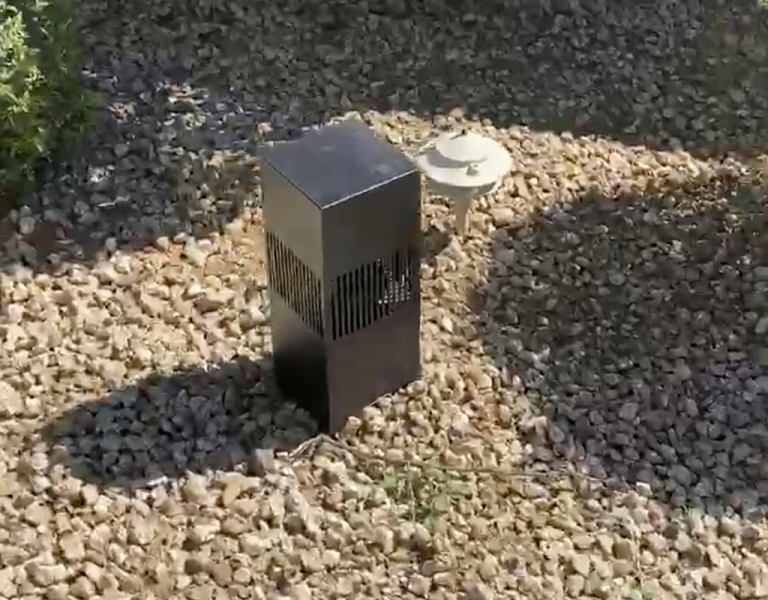
| Directional landscape satellite | Planting beds, lawn edges, pool perimeters, paths, and large irregular yards. | Brings sound near listeners, blends with landscaping, and can form overlapping low-level coverage. | Coordinate with irrigation, drainage, roots, future plant growth, pets, gardeners, mowing, trip paths, stake stability, and direct-burial or conduit instructions. |
| Bollard, planter, rock, or omnidirectional form | Locations where a directional satellite is visually unsuitable or broader local coverage is desired. | Can integrate with hardscape or planting and may cover a gathering area without a wall. | Do not assume the appearance defines performance. Review radiation pattern, serviceability, drainage, vandal/impact risk, anchoring, and boundary spill. |
| Hardscape or buried subwoofer | Landscape beds, walls, patios, and outdoor zones that need bass support. | Lets small satellites concentrate on midrange and treble while a purpose-built enclosure supplies low-frequency energy. | Check drainage, excavation, soil loading, port clearance, irrigation, utility locating, cable and splice method, service path, vibration, and bass at property edges. |
What “waterproof outdoor speakers” really means
“Waterproof” is often used as a shopping phrase, but it is not enough for a permanent design. An IP code describes tested resistance to solids and water under defined conditions; it does not automatically describe UV stability, corrosion, extreme surface temperature, freeze/thaw behavior, fertilizer exposure, irrigation pressure, insects, wind, or a connection left in standing water.
Ratings also vary within a brand. For example, Sonance currently lists its Mariner MX surface-mount series as IP66, but that rating should not be transferred to another model with a similar shape. Read the exact data sheet, installation manual, warranty conditions, and approved mounting orientation for every speaker, subwoofer, connector, enclosure, and amplifier location.
Outdoor speaker placement around patios and pools
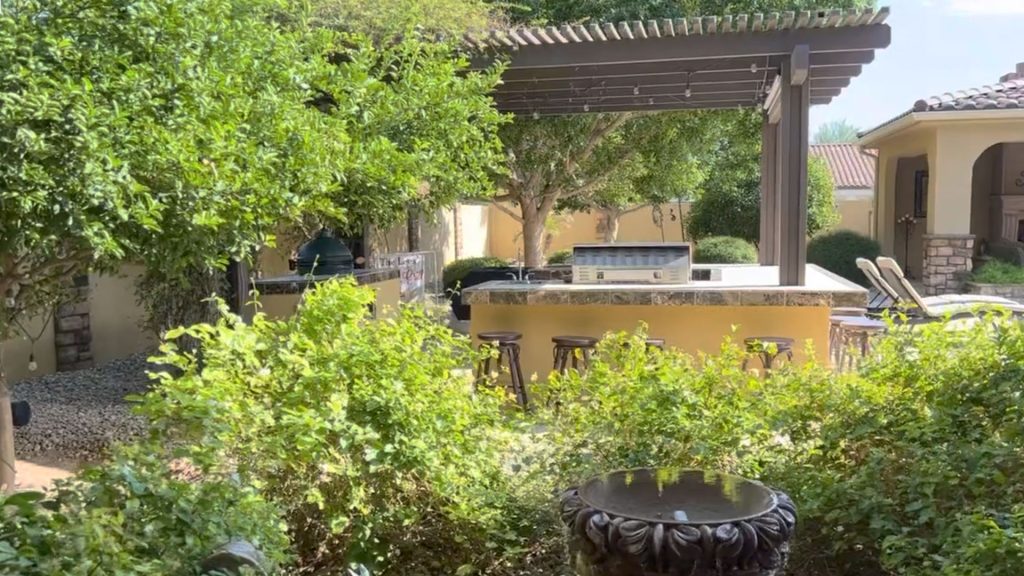
Covered patios and outdoor kitchens
A covered patio often benefits from smaller coverage zones rather than one pair at the far corners. Place speakers so that the primary seating and cooking areas fall within useful coverage without forcing the nearest seats directly under or in front of a loudspeaker. With ceiling speakers, account for beam spacing, ceiling height, fan blades, heaters, skylights, cabinetry, and the location of the grill hood. With surface-mount speakers, aim across the audience rather than straight out into the yard.
Hard tile, glass, stone, and stucco can make a protected patio sound brighter and more reflective than the open yard. Separate level control lets the covered area remain comfortable while pool or lawn speakers operate at a different level. A television area may also need tighter lip-sync and directional coverage than background music elsewhere; keep display selection on the dedicated outdoor TV comparison guide.
Pool decks and water-facing seating
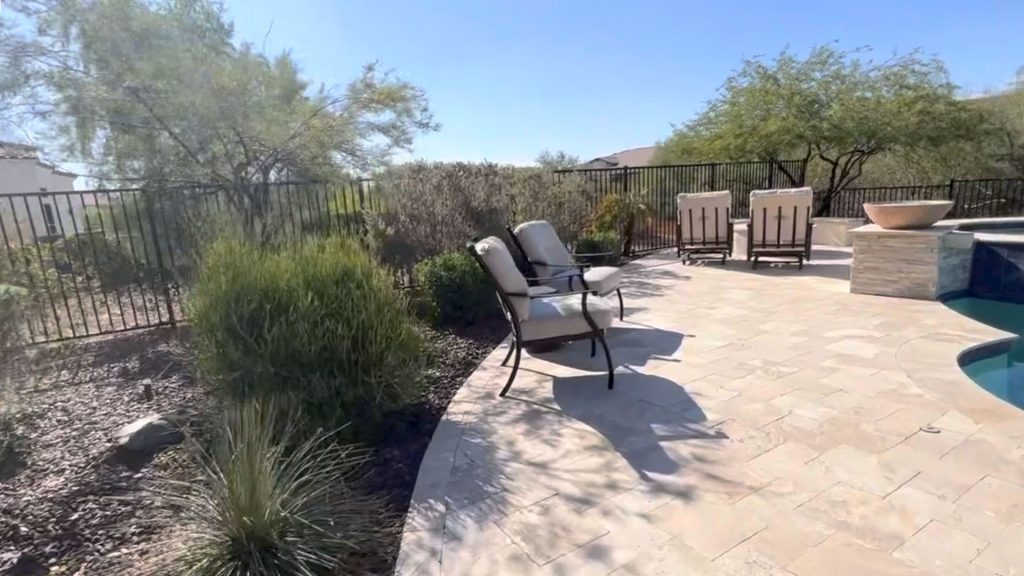
Pool audio should be designed around where ears will be, not simply around the water’s outline. Loungers, a raised spa, a shallow shelf, a cabana, and a dining table can sit at different elevations and distances. Landscape speakers can be placed around the usable perimeter and aimed inward across those positions. Avoid aiming the entire system away from the home or toward adjacent lots merely because the house is the easiest mounting surface.
Keep speakers and wiring out of circulation paths, maintenance routes, gate swings, splash concentrations, and direct irrigation. Do not improvise electrical power near water. The U.S. Consumer Product Safety Commission advises that electrical work around pools follow the applicable code and be handled or inspected by a qualified pool-and-spa electrician, including required grounding and GFCI protection. Final setbacks and methods depend on the equipment, circuit, adopted code, and authority having jurisdiction; this guide is not an electrical installation procedure.
Large yards, guest houses, and sport areas
A deep or segmented property should not be solved by turning up the pair on the main house. Treat a guest-house patio, lawn, firepit, or sport court as its own use area. That may call for another audio zone, localized amplification, a long low-voltage route, fiber or network backbone, or planned conduit. If an app or automation interface must work at the far end of the yard, the outdoor network design must reach the same places reliably.
Annotated backyard layout: one system, four listening behaviors
The schematic below illustrates the planning logic for a hypothetical Arizona property. It is not a fixed speaker count or scale drawing. The patio uses architectural or surface-mount coverage, the pool and lawn use inward-facing landscape satellites, the guest house has independent control, and the subwoofer sits within the listening zone rather than at the outer boundary.
ZONE 1
ZONE 3
ZONE 2
ZONE 4
- Architectural, surface-mount, or landscape speaker
- Purpose-built outdoor subwoofer
- Pool
The drawing also demonstrates why “How many pool speakers do I need?” rarely has a trustworthy one-number answer. Moving the chairs, changing the property boundary, adding a ramada, or separating the lawn from the pool can change the zone map and speaker layout even when total square footage stays the same.
Bass and buried subwoofers outdoors
Small outdoor speakers can reproduce music, but asking them to deliver deep bass across a yard consumes headroom and often makes the system sound strained. A purpose-built outdoor subwoofer takes over the low-frequency range so satellites can work within a more comfortable band. The audible result can be fuller at ordinary listening levels—not simply louder.
Buried and hardscape subwoofers require more planning than their low visibility suggests. Manufacturer instructions may control excavation dimensions, gravel base, drainage, backfill, vent orientation, clearances, wire topology, and allowed connection methods. A buried enclosure still needs an acoustic opening above grade, and that opening must remain clear of mulch, irrigation, plants, insects, and landscape work.
Location also influences what neighbors hear. Low frequencies spread broadly and can travel around barriers more readily than higher frequencies. Do not place a subwoofer at the property edge merely because a planter is available. Test bass at seating locations, inside nearby bedrooms, and at relevant boundaries; then align level, crossover, polarity, delay, and equalization within the selected system’s limits.
Zones and control: make the outdoor sound system easy to live with
An audio zone is an area with its own useful source and level behavior. If the patio always plays with the pool at the same volume, they may function as one zone. If someone may watch a game under the ramada while another person listens to music by the pool, or if the guest house follows a different schedule, those areas need independent control paths.
Useful outdoor controls may include:
- Separate patio, pool, lawn, and guest-house volume where activities and distances differ.
- Easy grouping so selected zones can play the same source during a gathering without becoming permanently tied together.
- Maximum-volume limits appropriate to each zone, speaker system, and neighbor relationship.
- Scheduled or one-touch shutdown so exterior audio does not remain on after the space is empty.
- Clear source ownership so one person’s phone does not unexpectedly interrupt another area’s program.
- Reliable outdoor control coverage from the home’s managed network rather than weak indoor Wi-Fi leaking through masonry and coated glass.
Control4’s published outdoor integration example uses separate landscape and pool-house audio zones and lets the owners group and control them from remotes, touch panels, or an app. It is an example of behavior, not a required brand or template. Use the interactive Whole-Home Audio Planner to think through zones, sources, speakers, and controls; Camelback Smart Homes can then design distributed audio around the platform and routines appropriate for the property.
Amplifier sizing without the shortcuts
Do not choose an amplifier from speaker count alone. The design must first establish the wiring architecture. A conventional low-impedance pair, a series/parallel landscape kit, a 70/100-volt distributed system, and a proprietary package present different loads and commissioning requirements.
A qualified design checks the selected manufacturer’s topology, each speaker’s nominal impedance or transformer tap, the total connected load per channel, cable length and gauge, required headroom, crossover and protection settings, simultaneous-zone demand, rack power, cooling, and future expansion. The goal is clean capability at the planned listening level without operating the amplifier or speakers outside their published limits.
Do not mix nominal impedances, transformer-tapped speakers, stereo/mono configurations, or wiring schemes casually. A landscape package that supports eight satellites on a specified amplifier does not prove that a different eight-speaker collection is safe. Follow the complete system manual and document the final wiring and settings.
Wiring and weather protection for Arizona outdoor speakers
Outdoor reliability is often lost at the connection, trench, or equipment location rather than at the speaker cone. The cable and every splice, gland, junction, bracket, fastener, conduit transition, and enclosure must suit its actual environment.
- Use an approved route. Coordinate low-voltage paths with existing utilities, pool equipment, irrigation, drainage, lighting, gas, roots, hardscape, gates, and future construction before digging. Arizona law requires underground-facility checks and completion of required marking before excavation; a locate does not replace plans and private-property investigation for owner-installed irrigation, lighting, or AV lines.
- Follow the selected manual. Use the specified direct-burial cable, conduit, connector, strain relief, polarity, loop topology, and splice method. “Outdoor cable” is not one universal construction.
- Keep connections serviceable. Record measurements from permanent landmarks, photograph trenches before backfill, label both ends, and preserve access rather than burying undocumented splices.
- Manage water, not just rain. Irrigation spray, pooling, roof runoff, pressure washing, and monsoon-driven water can reach areas that seem protected during a dry walkthrough.
- Protect the electronics. Indoor amplifiers, streamers, network switches, and power supplies need a suitable conditioned location with ventilation and service access. A generic plastic weather box can trap destructive heat.
- Commission after landscaping. Verify polarity, load, channel routing, levels, coverage, bass, control, and boundary spill after plants, furniture, gates, and hardscape are in place.
Arizona heat, sun, dust, monsoons, and irrigation
Air temperature alone does not describe an Arizona installation. Direct solar exposure can heat a dark enclosure or west-facing bracket beyond the ambient reading. Fine dust can collect in grilles and connectors. Monsoon wind can drive rain sideways under a roof. Desert landscaping may still include high-pressure irrigation, fertilizer, soil salts, gravel movement, and crews using blowers or trimmers.
Evaluate each location by its worst credible exposure, then verify the exact product’s published limits. Shade is useful, but a shaded ceiling can still trap heat. An IP rating is useful, but it does not replace temperature and UV data. Corrosion-resistant hardware is useful, but only when the fasteners, bracket, enclosure, connector, and mounting substrate work as a system. Schedule inspection after the first monsoon season and after major landscape changes.
Neighbor-friendly outdoor audio design
Property boundaries should appear on the coverage drawing. Aim directional speakers inward, keep them near listeners, use more modest sources instead of distant high-output boxes, and place subwoofers away from shared edges where practical. During commissioning, listen and measure at the seats that matter and at the boundary—especially with bass-heavy material.
Local noise rules vary by city, property type, time, and circumstance. Phoenix publishes guidance for its event and loud-party ordinances. Scottsdale’s current city information says its existing ordinance remains in force while potential revisions are being evaluated; Scottsdale also notes that disruptive noise can be addressed even outside a late-night threshold. HOA rules and private covenants may add stricter requirements. Verify the rules that apply to the actual address rather than relying on a generic online decibel chart.
Technology can support good habits: zone limits, a late-evening scene, automatic exterior shutdown, and easy local volume control are more reliable than expecting every guest to understand a complex rack. No automation setting overrides an ordinance or a neighbor’s legitimate concern, but thoughtful defaults reduce accidental spill.
Three common Arizona outdoor-audio scenarios
Compact covered patio
Likely approach: one carefully placed pair of outdoor-rated architectural or surface-mount speakers, with coverage centered on dining and seating rather than the entire yard.
Watch for: the nearest seat being too close, fan/heater conflicts, hard reflections, west sun, grill heat and grease, and whether television audio needs separate behavior.
Pool plus ramada
Likely approach: independent patio and pool zones; protected architectural speakers at the ramada and inward-facing landscape satellites around the pool, supported by an outdoor subwoofer if fuller bass is desired.
Watch for: water and electrical clearances, splash and irrigation, gate and walkway conflicts, control-device Wi-Fi, differing listening levels, and nighttime boundary spill.
Large yard with guest house
Likely approach: a scaled multi-zone design with distributed landscape coverage near activity areas, localized or centrally planned amplification, documented underground routes, and a network/backbone plan for the detached structure.
Watch for: cable length and topology, utilities, future landscape growth, service access, simultaneous sources, guest privacy, and whether every area truly needs to play together.
Finished retrofit with limited trenching
Likely approach: inspect walls, eaves, planter edges, equipment rooms, and existing conduit before combining surface-mount, landscape, or supported wireless components.
Watch for: visible power, proprietary wireless dependencies, weak outdoor networking, inaccessible splices, patching, and accepting poor placement merely because it is easy.
Outdoor speaker planning checklist
- Define the listening goal. Background music, focused patio listening, pool entertainment, and television sound have different coverage needs.
- Mark every listening area. Include chairs, tables, grills, pool positions, fire features, lawns, courts, paths, and detached buildings.
- Mark every quiet and sensitive area. Include bedrooms, offices, neighbors, property edges, and HOA constraints.
- Build a zone map. Separate spaces that need different sources, volume, schedules, or shutdown behavior.
- Select speaker forms by location. Match architectural, surface-mount, landscape, bollard/rock, and subwoofer options to coverage, visibility, and exposure.
- Verify environmental ratings. Check exact model data for water, dust, heat, UV, corrosion, mounting, drainage, and warranty conditions.
- Design bass deliberately. Reserve appropriate hardscape or buried-subwoofer locations and evaluate sound at boundaries.
- Engineer amplification and wiring. Confirm topology, load, cable, routes, connectors, rack conditions, protection, and expansion before purchase or trenching.
- Coordinate the site. Align AV plans with pool, landscape, irrigation, electrical, lighting, gas, hardscape, drainage, and network work.
- Commission the finished property. Test real listening positions, adjust aim and level, verify controls and limits, and document the final system.
For shorter answers about music zones, outdoor-speaker quantity, weather exposure, and wired versus wireless audio, visit the whole-home and outdoor audio FAQ library. For examples of discreetly integrated outdoor technology, browse the Camelback Smart Homes project gallery.
Authoritative planning sources
The technical and local-policy claims in this guide were reviewed on September 4, 2026. Product data, adopted codes, ordinances, and site conditions can change. The exact manufacturer documentation and current requirements for the project address control the final design.
- Episode Terrain System installation manual: coverage, aiming, spacing, irrigation, and wiring guidance
- Sonance Landscape Solutions: distributed satellite and in-ground subwoofer system concept
- Sonance Mariner MX: current surface-mount outdoor ratings and model data
- Control4: outdoor zone and control integration example
- U.S. Consumer Product Safety Commission: electrical safety around pools, spas, and hot tubs
- Arizona Revised Statutes § 40-360.22: underground-facility locating before excavation
- City of Phoenix: current building, pool, and electrical code adoptions
- City of Scottsdale: current building and electrical code information
- NIOSH: how distance can affect sound level under suitable conditions
- City of Phoenix: current laws and ordinances resource page
- City of Scottsdale: current special-noise ordinance status and resources
Frequently asked questions about outdoor speakers
How many outdoor speakers do I need for my patio, pool, or yard?
The quantity depends on listening locations, speaker dispersion and output, mounting height, terrain, structures, desired level, zoning, and property boundaries—not square footage alone. Several speakers closer to listeners often create more even coverage at lower local volume than one distant pair. Use the selected manufacturer’s data and a scaled site plan, then verify the finished coverage onsite.
Are wall-mounted or landscape speakers better outdoors?
Wall-mounted speakers can be a strong choice for covered patios, structures, and focused seating when the mounting surface and aim are suitable. Landscape speakers are often better for pools, planting beds, irregular yards, and distant activity areas because they bring sound closer to listeners. Many properties benefit from both types in separate or coordinated zones.
How far apart should landscape speakers be?
There is no universal spacing. Current manufacturer examples range from about 6–8 feet for one Episode Terrain system to 8–10 feet for a Sonance landscape family, but those numbers apply to those systems and conditions. Final spacing must follow the exact speaker’s dispersion, output, mounting, wiring design, site geometry, and installation manual.
Are outdoor speakers waterproof?
Some models carry specific dust-and-water ratings, but “waterproof” is not a complete design specification. Verify the exact model’s IP rating, temperature range, UV and corrosion resistance, approved orientation, connection method, drainage, and warranty. A covered patio, exposed wall, irrigated planting bed, and pool edge are different environments.
Where should speakers point around a pool?
Directional speakers should generally aim across the intended listening positions and inward toward the usable pool and seating areas, not outward toward neighboring property. Keep them clear of walkways, gates, direct spray, standing water, and maintenance routes. Final placement must also satisfy the equipment instructions and applicable pool-area electrical requirements.
Do outdoor speakers need a buried subwoofer?
No, but a purpose-built outdoor subwoofer can add low-frequency foundation and reduce the bass burden on small satellites. It is most useful when the listening goal calls for fuller music across a defined zone. Its location, drainage, service access, cable route, crossover, alignment, and sound at property boundaries must be planned.
Are wired or wireless outdoor speakers better?
Permanent wired speakers usually offer predictable signal paths and can keep active electronics indoors, while wireless products can help in selected retrofits. “Wireless” speakers may still require outdoor power and dependable Wi-Fi or a proprietary radio link. Compare the complete power, network, synchronization, weather, service, and long-term support requirements.
Can outdoor audio integrate with a smart-home system?
Yes. A compatible system can provide separate zones, source selection, grouping, volume limits, schedules, and one-touch shutdown from approved remotes, touch panels, keypads, or apps. The experience depends on compatible audio electronics and reliable networking, so control behavior should be designed with the speaker, amplifier, and outdoor-coverage plans.
Plan the coverage before the equipment list
Camelback Smart Homes can map your patio, pool, landscape, guest house, quiet areas, wiring routes, audio zones, bass strategy, control, and Arizona exposure into one coordinated outdoor sound system.