
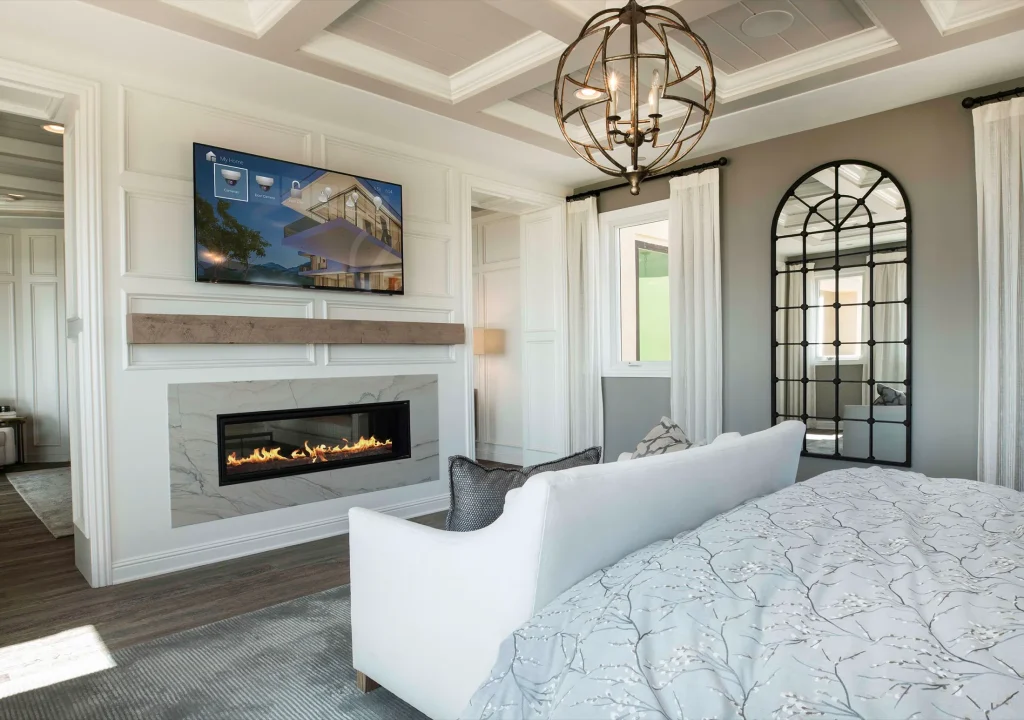

What is Entertainment Cabinet?
Entertainment Cabinet is furniture or built-in millwork designed to support and visually organize a room’s display, speakers, source devices, accessories, décor, and cable paths as part of the finished interior.
How Entertainment Cabinet works in a connected system
An entertainment cabinet integrates technology with the room-facing design. It may frame a television, provide shelves for visible components, conceal doors and drawers, support a soundbar, store media and controllers, or incorporate a lift. Technology changes the cabinet requirements: electronics need ventilation and service clearances, remote or wireless signals need viable paths, speakers need openings that do not block sound, and cables need generous bend space. Shelves and mounts must carry actual loads. Removable backs, labeled connections, and access to power or network equipment prevent simple service from becoming a millwork project. The best cabinet is developed from an equipment schedule rather than a generic rendering.
Why Entertainment Cabinet matters in Scottsdale projects
In a Scottsdale, Arizona home, an entertainment cabinet may need to coordinate custom interiors with safe ventilation for installed electronics. Arizona heat and strong daylight can add thermal load near windows, so closed compartments need an intentional ventilation strategy. The cabinet can refine the room visually without pretending electronics can operate indefinitely in sealed, inaccessible spaces.
Planning and installation considerations
- Finalize an equipment list with dimensions, weights, connector locations, ventilation needs, and service clearances before shop drawings are approved.
- Protect speaker openings, infrared or wireless operation, cable bend radius, and airflow from decorative panels or tightly fitted doors.
- Provide removable access and a route for future cable changes without dismantling major finished sections.
A common point of confusion
An entertainment cabinet and an equipment rack are not interchangeable. The cabinet is part of the occupied room and may hold user-facing components; a rack is a structured mounting and service environment for centralized electronics, often with different cooling and access needs.
Frequently asked questions
Can electronics operate behind closed cabinet doors?
They can if the compartment has adequate intake and exhaust airflow, suitable operating conditions, control connectivity, and required clearances. Heat output varies widely, so decorative openings alone should not be assumed sufficient. Temperature monitoring or active ventilation may be appropriate.
When should the technology integrator review cabinet drawings?
Before fabrication. Early review allows device dimensions, mounting, airflow, speaker locations, power, cable routes, controls, and service panels to be coordinated. Changes are usually easier on drawings than after finished millwork arrives at the home.
About this definition
Camelback Smart Homes publishes this glossary for homeowners, design professionals, builders and business teams comparing integrated technology. We separate general concepts from project-specific recommendations and check changing product or protocol details against first-party documentation when appropriate.
Actual system requirements depend on construction, wiring, network conditions, equipment versions, environmental exposure and the goals of the people using the space.