
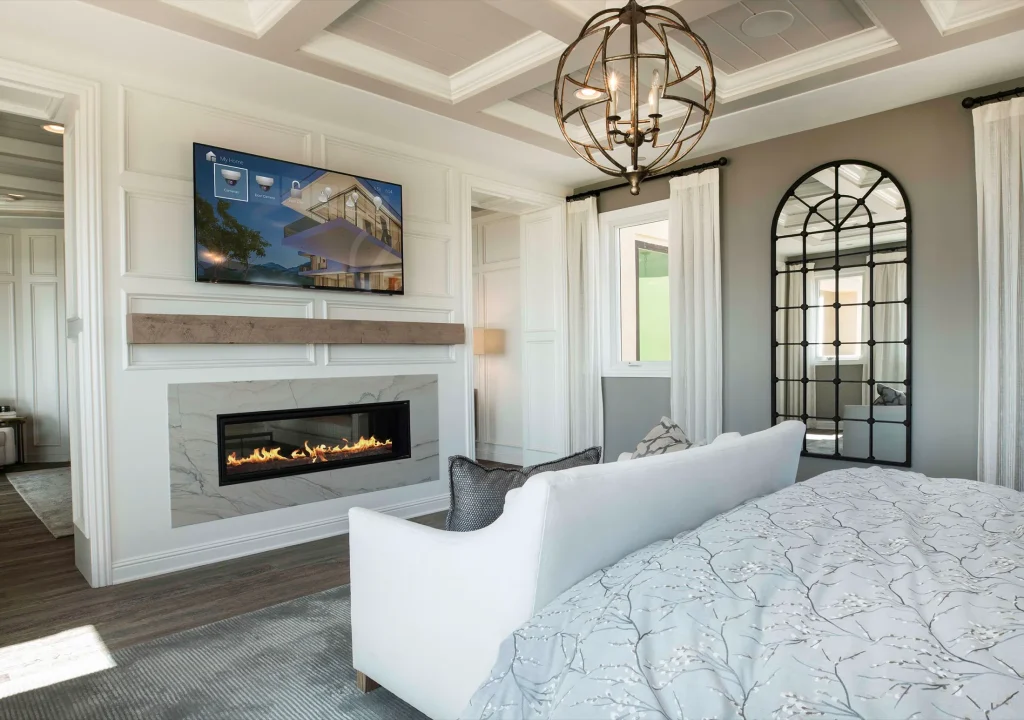

What is Home Mode?
Home Mode is a named system state indicating that the property is in its normal occupied condition. Programming can use that state to allow, suppress, or modify schedules, notifications, lighting, comfort, access, and entertainment behavior without issuing every command at the moment the mode changes.
How Home Mode works in a connected system
A mode is a piece of system context. It may be selected manually, inferred from an approved event, or set by another routine. Individual automations then consult the mode before acting: pathway lights may follow ordinary occupied timing, indoor cameras may follow privacy preferences, and comfort settings may use the household’s normal range. The mode should have a visible status and a clear owner. If several platforms each maintain their own idea of “home,” conflicting states can develop. Transitions also need care so returning home does not unexpectedly turn on every room.
Why Home Mode matters in Scottsdale projects
For a Scottsdale, Arizona residence, Home Mode can preserve normal comfort and daylight routines while Away Mode uses more conservative rules. Temperature limits should still be coordinated with the actual HVAC system, furnishings, pets, and occupants. A universal aggressive setback is not appropriate for every home.
Planning and installation considerations
- Write down exactly what Home Mode changes immediately, what it merely enables, and which subsystems maintain their prior state.
- Provide a visible manual selector and prevent geofencing, schedules, and access events from fighting over the mode without a defined priority.
- Separate occupancy context from alarm status; a home mode in an automation platform does not certify or replace a security system’s armed state.
A common point of confusion
Home Mode is not necessarily a scene. A scene usually recalls settings immediately, while a mode can remain active as a condition that influences future events. Changing into Home Mode might run a small arrival action, but its larger purpose is to tell other automation logic how to behave afterward.
Frequently asked questions
How should a home switch into Home Mode?
The safest method depends on the household. A keypad command, app choice, supported access event, or carefully designed geofence can work. High-consequence changes should not rely on a single uncertain signal, and residents need an obvious manual correction.
Can Home Mode be different for daytime and nighttime?
Yes. Some systems use separate modes, while others combine Home Mode with time, daylight, or a Goodnight state. Keep the number of states understandable and document which condition wins when more than one applies.
About this definition
Camelback Smart Homes publishes this glossary for homeowners, design professionals, builders and business teams comparing integrated technology. We separate general concepts from project-specific recommendations and check changing product or protocol details against first-party documentation when appropriate.
Actual system requirements depend on construction, wiring, network conditions, equipment versions, environmental exposure and the goals of the people using the space.