
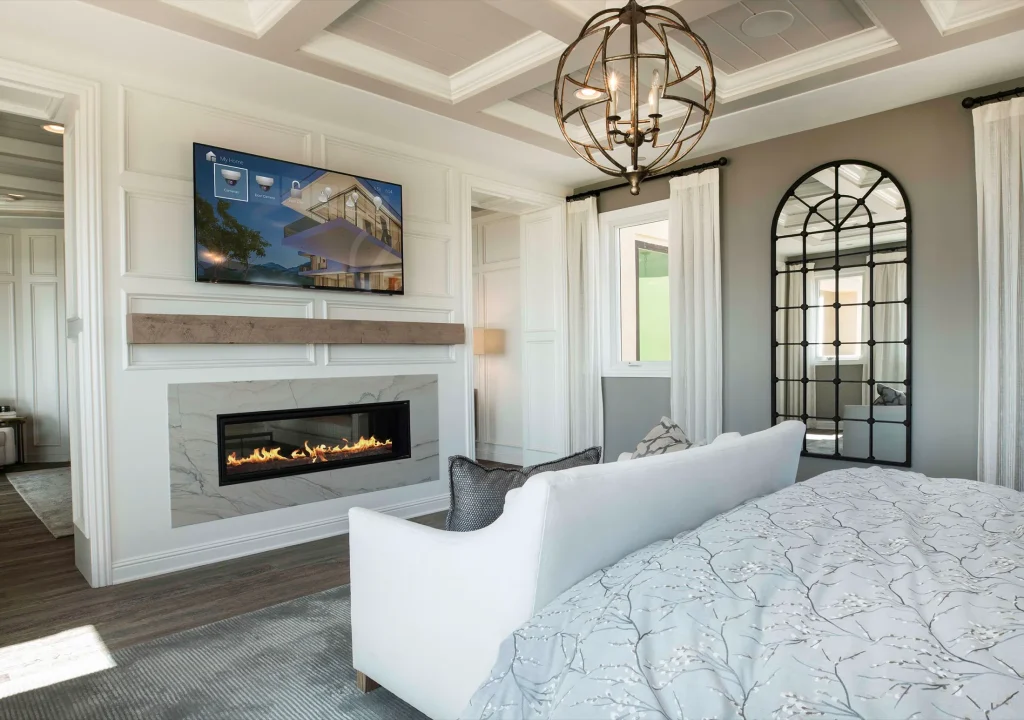
What is Goodnight Scene?
Goodnight Scene is a homeowner-initiated bedtime routine that sends a planned set of commands to selected systems. It can turn off common-area lights and entertainment, set safe pathway lighting, lower shades, and request supported lock or comfort actions while leaving exceptions alone.
How Goodnight Scene works in a connected system
The scene is typically launched from a bedside keypad, app, or another deliberate control. Its macro may sequence rooms to avoid abrupt darkness, retain night lights, stop distributed audio, and check device feedback. Bedrooms, late arrivals, guests, pets, and overnight equipment need explicit exceptions. Because locks, garage doors, alarms, and HVAC affect safety or property access, those actions should use supported integrations and clear confirmation. A scene can also set a nighttime mode that modifies later motion or notification behavior rather than trying to complete every nighttime decision at once.
Why Goodnight Scene matters in Scottsdale projects
In Scottsdale, Arizona homes, a Goodnight Scene may coordinate shades and comfort without applying extreme setbacks during hot weather. It can also preserve a safe, low-level path between bedrooms and living areas. The final behavior should come from household routines, not from a generic script copied to every property.
Planning and installation considerations
- Interview household members about different bedtimes, guest rooms, pets, overnight charging, medical equipment, and areas that must remain accessible or lit.
- Separate immediate commands from the nighttime mode, and show which locks, doors, alarm states, or devices did not confirm their requested status.
- Provide easy bedside adjustments and a clear cancel or wake action so residents are never trapped in a rigid whole-home state.
A common point of confusion
A Goodnight Scene should not silently imply that every door is locked or the alarm is armed. Sending a command is different from receiving confirmed state, and some integrations expose only limited feedback. The interface should describe what is actually known instead of offering a reassuring but unsupported summary.
Frequently asked questions
Can a Goodnight Scene run automatically at a fixed time?
It can, but a manual bedtime action is often less surprising because routines vary. A schedule may prepare selected lighting or reminders, while a deliberate press handles shutdown. If automatic, include occupancy conditions, warnings, and an easy override.
What lighting belongs in a Goodnight Scene?
That depends on circulation and preferences. Common-area lights may fade off while stairs, halls, or bathrooms retain low levels. Fixture dimming quality, minimum levels, sensor behavior, and glare should be tested after dark.
About this definition
Camelback Smart Homes publishes this glossary for homeowners, design professionals, builders and business teams comparing integrated technology. We separate general concepts from project-specific recommendations and check changing product or protocol details against first-party documentation when appropriate.
Actual system requirements depend on construction, wiring, network conditions, equipment versions, environmental exposure and the goals of the people using the space.