
Separate low-voltage signal from household power
HDMI, optical audio, Ethernet, coaxial, speaker, control, and other signal cables are commonly described as low voltage. The television and most source devices still receive household power through branch-circuit wiring, receptacles, or listed power equipment. Those categories have different cable ratings, boxes, supports, pathways, separation requirements, and qualified trades. A clean installation begins by drawing both routes rather than bundling every visible cord into one undefined path.
Do not fish a television's detachable power cord, an ordinary extension cord, or a power strip cord through a wall to reach a lower outlet. NFPA's National Electrical Code addresses uses that are not permitted for flexible cords, including using them as a substitute for fixed wiring or concealing them in walls, subject to its specific provisions. CPSC likewise describes extension cords as temporary devices and warns that improper use can create fire and shock risks. Concealed display power should be resolved with a properly installed receptacle or a listed system intended for that exact application.
- Identify every cable by function before choosing a pathway.
- Keep flexible power cords visible and used only as their listing and instructions permit.
- Have a qualified electrical professional evaluate new, moved, or uncertain receptacles and branch wiring.
- Do not share boxes or pathways unless the complete listed system and adopted requirements permit it.
Choose among surface, behind-TV, and remote-equipment layouts
Paintable surface raceway is often the lowest-impact option. It can create a deliberate vertical or horizontal route without opening the wall and remains accessible when a cable changes. Select a listed raceway and fittings appropriate to the cable category and install them as intended; do not overfill a small decorative channel or force tight bends. Matching wall paint can make the route quiet without pretending it is invisible.
A behind-TV layout can conceal a small streaming device and short signal leads, but recessed boxes have finite volume and may trap heat. Larger source collections are usually easier to cool, power, connect, and service in nearby furniture, a ventilated cabinet, or a central rack. Remote equipment removes visual clutter yet adds cable-length, signal-transport, control, network, and troubleshooting requirements. The planner favors the simplest serviceable option that meets the finish goal rather than hiding every device in the wall.
Plan conduit and replaceable pathways around real cable behavior
A pathway can make future replacement easier, especially for connection standards that evolve. Its usefulness depends on internal diameter, bend radius, number and severity of bends, pull points, fill, end locations, firestopping, and whether both ends remain accessible after the display, cabinetry, and finishes are installed. A small corrugated tube with sharp turns may exist on a plan yet reject the connector that eventually needs to pass through it.
Cable distance must follow the routed path and include service loops. High-bandwidth video performance can depend on cable type, length, direction, connectors, source, display, and active electronics, so an untested long cable should not be buried as a permanent assumption. For remote equipment, validate the complete signal chain at the intended format before closing access, and provide network and control paths that do not depend on line-of-sight infrared unless that is intentionally part of the design.
- Keep both pathway ends accessible and protected.
- Use sweeping bends and pull points appropriate to the largest expected connector.
- Separate pathway planning from the approval of any cable placed inside it.
- Test long or active signal paths end to end before finish repair.
Let wall access and finish quality drive the repair plan
An unobstructed interior stud bay may allow openings near the television and lower connection point. Insulation, horizontal blocking, fire stops, plumbing, ducts, electrical wiring, structural bracing, and back-to-back fixtures can interrupt that route. Exterior walls add air, moisture, thermal, and vapor-control concerns. Masonry may require a surface route, a purpose-built chase, millwork, or carefully planned cutting and restoration rather than routine fishing.
A fully concealed result can require exploratory assessment, one or more controlled openings, patching, texture blending, primer, and painting beyond the immediate cut. Finish matching is especially visible in strong side light or on specialty plaster, wallpaper, tile, stone, paneling, or high-sheen paint. Decide before work begins whether the goal is a localized repair, a full wall refinish, or an architectural solution such as millwork; the least visible cable route is not always the least visible overall project.
- Scan and assess before cutting, while recognizing that detection tools have limitations.
- Confirm whether matching paint, texture, tile, stone, wallpaper, or panel material is available.
- Protect insulation, air sealing, waterproofing, and rated assemblies during any approved opening.
- Photograph the verified path before repairs conceal it.
Fireplaces, exterior walls, masonry, and older finishes need special care
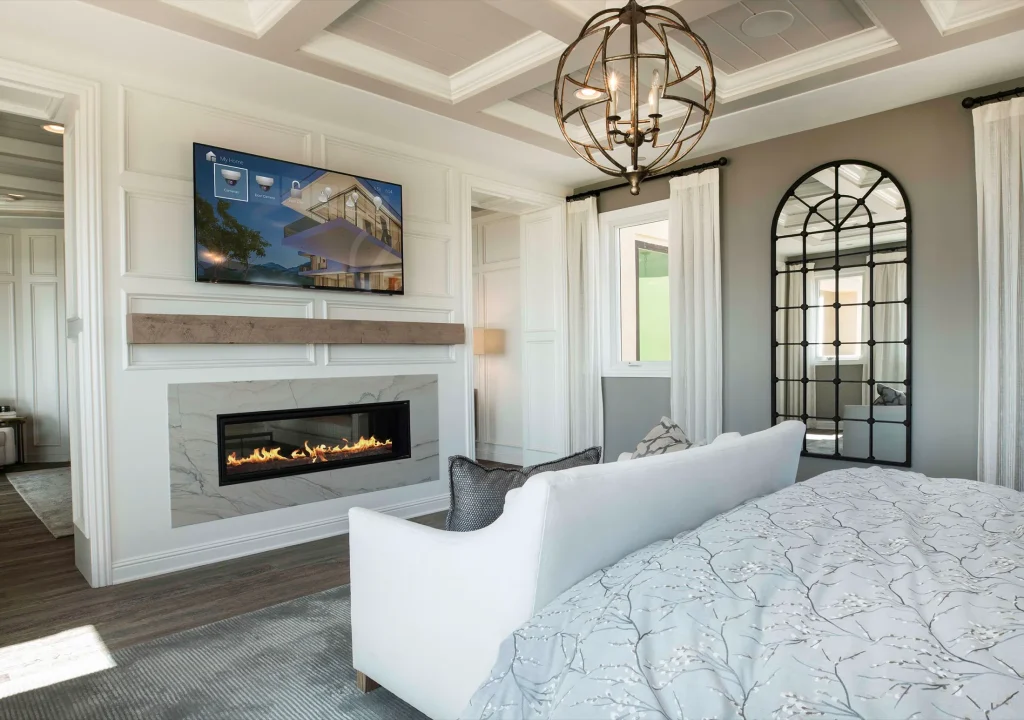
A fireplace wall can contain a chimney, flue, listed fireplace enclosure, heat-clearance zones, framing restrictions, gas piping, power, and manufacturer-required access. Its surface temperature and mounting substrate also affect the television and electronics. Do not assume that a cavity above a fireplace is an ordinary stud bay or that a narrow chase is available for new wiring. Obtain the fireplace documentation and have the wall and mounting concept evaluated before drilling or opening it.
Homes built before 1978 may contain lead-based paint. EPA explains that cutting, sanding, and other renovation work can create hazardous lead dust and that paid renovation firms performing covered work must follow the Renovation, Repair and Painting program. Unknown wall age or painted layers should stop exploratory cutting until the appropriate lead-safe approach is established. Similar caution applies to suspected asbestos-containing materials, water intrusion, damaged masonry, and any concealed condition outside the installer's qualified scope.
- Fireplace or chimney chase: obtain product information and verify heat, structure, utilities, and service access.
- Exterior wall: preserve water, air, thermal, pest, and vapor-control layers.
- Masonry or stone: verify anchors, substrate, routes, dust control, and finish restoration.
- Pre-1978 paint or uncertain hazardous materials: use the applicable professional testing and work practices before disturbance.
A clean installation stays cool, connected, and serviceable
Concealment is successful only if the television can still move on its mount, cables do not pinch, connectors are not forced into sharp bends, equipment can release heat, wireless remotes and networks remain reliable, and every device can be reset or replaced. Recessed boxes, articulating mounts, soundbars, and thick plugs compete for the same shallow space. Check the television's input orientation and the mount's full movement before fixing boxes or pathway exits.
Professional verification is required when power must be added or relocated, the wall contains unknown utilities or structure, the route enters a rated assembly, the display is over a fireplace, masonry or exterior-envelope work is proposed, the cable path is unusually long, or safe service access cannot be maintained. After installation, document cable IDs and pathway endpoints, test every source at its intended resolution and control method, operate the system long enough to reveal heat or connection problems, and leave the receptacles and equipment accessible.
Sources + limitations
What supports this Guide.
- NFPA 70: National Electrical Code Development
- U.S. Consumer Product Safety Commission: Household Extension Cords Can Cause Fires
- U.S. Consumer Product Safety Commission: Extension Cords
- U.S. EPA: Renovation, Repair and Painting Program for Consumers
- CEDIA: The Ultimate Smart Home Wiring Guide
Planning boundary
Never conceal an ordinary extension cord, power-strip cord, or television power cord inside a wall. New or relocated power, unknown concealed utilities, rated assemblies, fireplace or masonry walls, exterior-envelope work, hazardous-material concerns, and structural uncertainty require qualified professional assessment and work that follows the adopted code, product listings, and manufacturer instructions.