
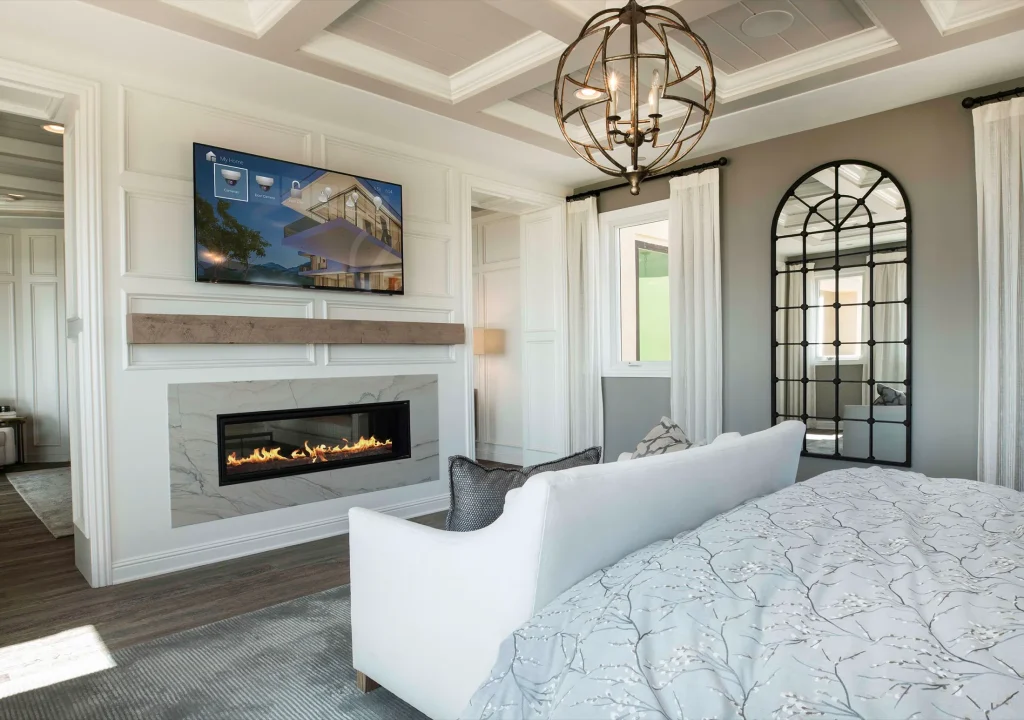

What is Room Control?
Room Control is an interface and programming scope focused on the systems a person uses within one room or defined zone. It brings the relevant lighting, shades, entertainment, comfort, and scenes together while hiding unrelated whole-home detail.
How Room Control works in a connected system
A room-control view knows the room context and routes commands to the devices or centralized resources assigned there. In a media room, it might select a shared video source, direct audio to that room, set local lights, and map remote buttons to the active activity. The same source may serve several rooms, so behind the interface the system still coordinates distribution and resource conflicts. Room-off behavior also needs definition: it may stop local playback and lights without shutting down a shared source another room is using.
Why Room Control matters in Scottsdale projects
In Scottsdale, Arizona properties, covered patios and adjacent outdoor areas may visually extend a great room without sharing the same control needs. Separate volume, glare, weather, occupancy, and neighbor considerations may make a patio its own zone even when it visually connects to the interior.
Planning and installation considerations
- Define room boundaries, shared sources, speaker and display assignments, adjacent zones, comfort ownership, and what “Room Off” may safely change.
- Place keypads, remotes, touch controls, and sensors where activities occur, then tailor permissions and labels to the room rather than the equipment rack.
- Test handoff between rooms, simultaneous source use, announcements, volume limits, scene overlap, and recovery when a shared device is unavailable.
A common point of confusion
Room control does not imply that all equipment is physically in the room. Sources, amplifiers, video distribution, and processors may be centralized. The room interface represents logical ownership and routing, while the underlying hardware can live in a ventilated equipment location elsewhere.
Frequently asked questions
Can two rooms use the same source at once?
Sometimes. Distribution hardware, source licensing, account rules, output capabilities, and desired independent control determine the answer. A shared source may force both rooms to show the same content even if audio volume remains separate.
What is the difference between a room and an audio zone?
A room is a user-interface and programming context; an audio zone is an independently controlled audio output area. One room can contain several zones, and one open area can be modeled differently depending on listening and control needs.
About this definition
Camelback Smart Homes publishes this glossary for homeowners, design professionals, builders and business teams comparing integrated technology. We separate general concepts from project-specific recommendations and check changing product or protocol details against first-party documentation when appropriate.
Actual system requirements depend on construction, wiring, network conditions, equipment versions, environmental exposure and the goals of the people using the space.