
What is Drapery Track?
Drapery Track is the rail and carrier assembly that guides fabric panels across an opening. A powered version uses a motor and drive mechanism to open, close, or stop the drapery at selected positions.
How Drapery Track works in a connected system
Carriers travel inside or along the track while the fabric hangs from them. The panels may draw from one side, split from the center, or stack in a planned direction. Motorized tracks can respond to a local switch, remote, schedule, or automation command, and many allow gentle manual movement or a dedicated override depending on the model. Track shape, span, curve capability, fabric weight, carrier spacing, and stack-back area all affect performance. The finished result also depends on structural attachment because the track supports both moving hardware and substantial textile weight.
Why Drapery Track matters in Scottsdale projects
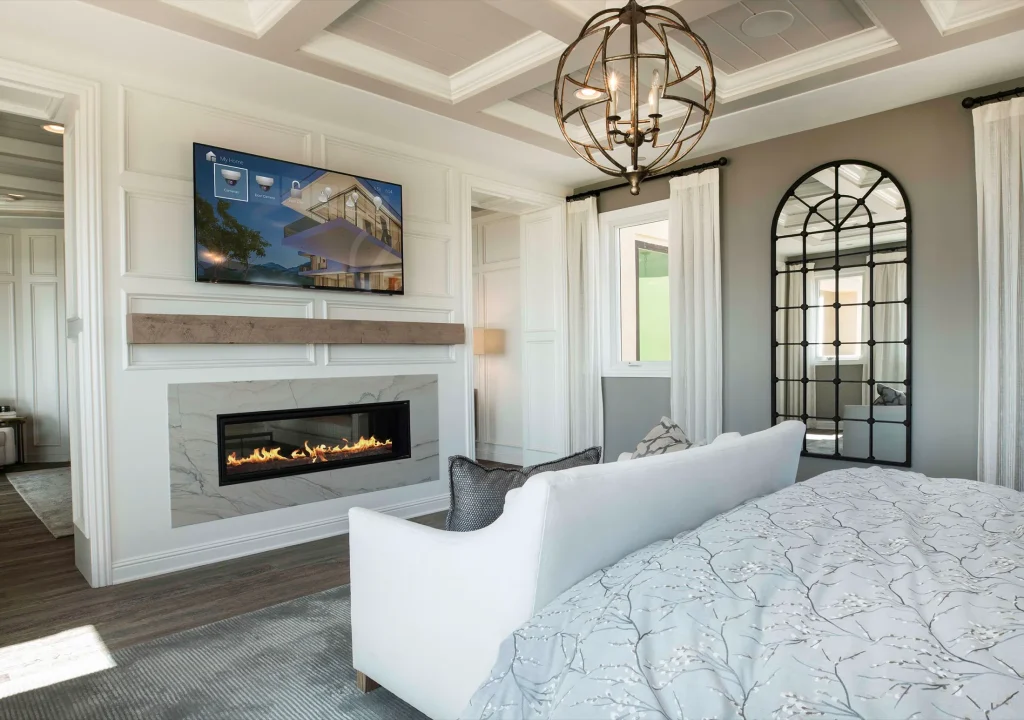
Large window walls and sliding doors in Scottsdale homes can make drapery stack-back especially important; gathered fabric should not block a doorway, view, or control when open. The solution is architectural coordination at the actual opening, not a climate-based assumption about every Arizona residence.
Planning and installation considerations
- Confirm one-way or center-open travel, preferred stack side, finished fabric fullness, and the clear opening needed for doors or views.
- Provide appropriate blocking and verify that ceiling, wall, or recessed mounting can carry the specified track and textile assembly.
- Coordinate power and motor location with valances, pockets, access panels, curtain headers, and the interior designer’s finished dimensions.
A common point of confusion
A motorized drapery track does not determine the look of the drapery by itself. Fabric weight, lining, heading style, fullness, stack allowance, and installation geometry remain central design decisions.
Frequently asked questions
Can a powered drapery track follow a curved wall?
Some track families support specified bends or factory curves, while others are intended only for straight runs. Radius, total length, fabric load, and motor capability must be checked for the selected product.
Where does the fabric go when the drapery is open?
It gathers in a stack at one or both ends of the track. That stack consumes wall or opening width, so its size and direction should be planned before the track and fabric are ordered.
About this definition
Camelback Smart Homes publishes this glossary for homeowners, design professionals, builders and business teams comparing integrated technology. We separate general concepts from project-specific recommendations and check changing product or protocol details against first-party documentation when appropriate.
Actual system requirements depend on construction, wiring, network conditions, equipment versions, environmental exposure and the goals of the people using the space.