

What is Acoustic Paneling?
Acoustic Paneling is an architectural treatment approach that uses coordinated panel surfaces across selected walls or ceilings to manage reflection, reverberation, diffusion, and room appearance.
How Acoustic Paneling works in a connected system
Acoustic paneling describes a system or field of treatment rather than one individual panel. It may use repeating fabric modules, wood slats over absorptive backing, perforated surfaces, suspended elements, or a mixture of absorptive and diffusive sections. Coverage, depth, open area, backing, edge conditions, mounting, and distribution determine acoustic behavior. Continuous-looking finishes can hide joints and attachment, but they still need verified data for the assembled configuration. Paneling can improve speech clarity, reduce harsh buildup, or shape a listening room’s reflections while supporting the interior design. It should be coordinated with outlets, controls, doors, base details, lighting, HVAC, fire-safety documentation where applicable, and future access. An attractive wall system without frequency-relevant performance may change appearance more than sound.
Why Acoustic Paneling matters in Scottsdale projects
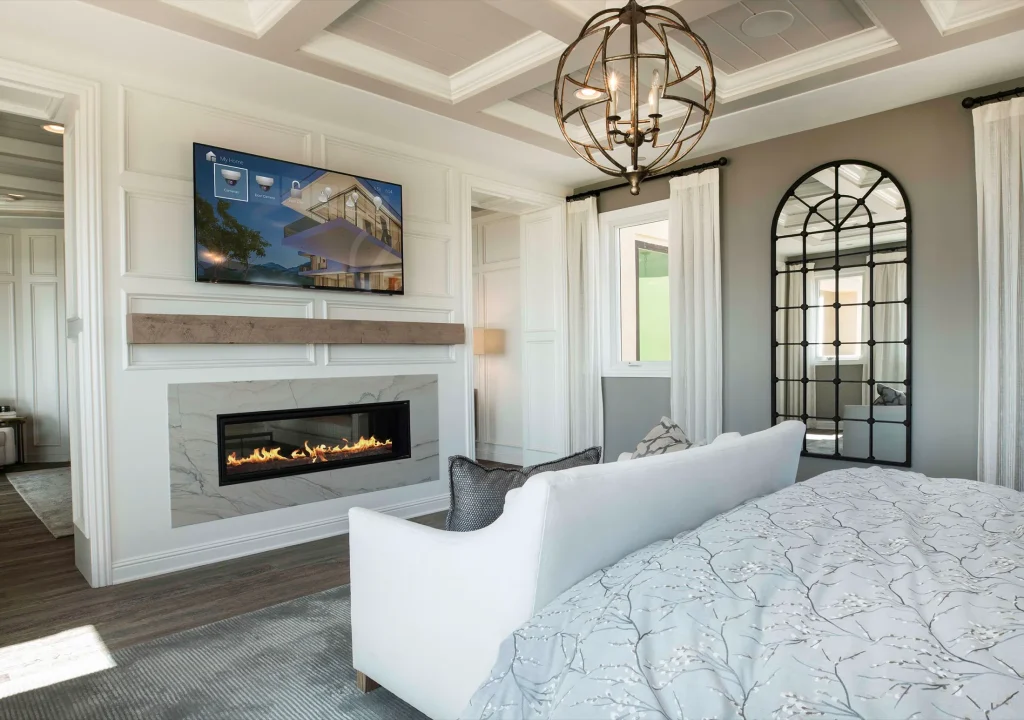
Acoustic paneling in a large Scottsdale, Arizona residence may use broad wall or ceiling surfaces to control room behavior without appearing added on. Strong side light can reveal seams, fabric direction, or slat irregularity. Full-scale samples help evaluate the finish while acoustic planning determines which surfaces should receive treatment.
Planning and installation considerations
- Establish acoustic objectives by frequency and room use, then determine total area, distribution, depth, backing, and whether absorption, diffusion, or hybrid behavior is needed.
- Review tested assembly data, finish samples, edge details, joint layout, attachment, substrate, cleanability, durability, and access to devices behind the paneling.
- Coordinate elevations with doors, trim, base, outlets, controls, speakers, artwork, lights, shades, HVAC, ceiling transitions, and responsible installation trades.
A common point of confusion
Acoustic paneling is not automatically effective because a wall has slats, grooves, fabric, or a soft appearance. The complete assembly needs appropriate openings, depth, material, backing, and tested or modeled behavior for the frequencies of concern.
Frequently asked questions
Is wood slat paneling acoustically absorptive?
It can be when slat spacing, open area, backing, depth, mounting, and materials create a tested absorptive assembly. Solid decorative slats applied directly to a hard wall may scatter some sound but should not be assumed to provide broad absorption.
Can acoustic paneling cover an entire wall?
It can, but full coverage is not always the best acoustic balance. Excessive high-frequency absorption without low-frequency strategy can produce uneven decay. The wall's devices, service points, finish joints, and attachment also need coordinated access.
About this definition
Camelback Smart Homes publishes this glossary for homeowners, design professionals, builders and business teams comparing integrated technology. We separate general concepts from project-specific recommendations and check changing product or protocol details against first-party documentation when appropriate.
Actual system requirements depend on construction, wiring, network conditions, equipment versions, environmental exposure and the goals of the people using the space.