
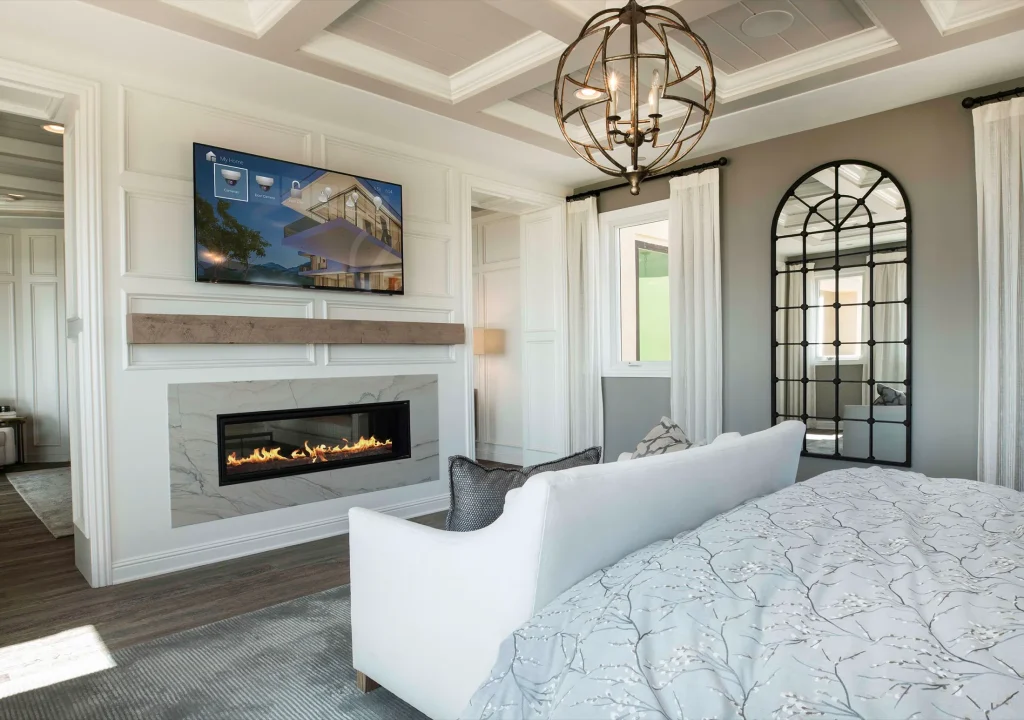

What is Concealed TV?
Concealed TV is a television installed behind, within, or beside a movable or visually integrated element that keeps the screen from view when it is not being watched.
How Concealed TV works in a connected system
A concealed TV can sit behind motorized art, a sliding panel, mirror glass, cabinetry, a lift, or another purpose-built architectural treatment. The method should match room use and display technology. The screen needs adequate ventilation, proper mounting, a clear viewing position, access to controls and sensors, and enough space for cables to move without strain. Motorized elements add limits for travel, weight, pinch areas, noise, timing, and manual recovery. Reflections, tint, or reduced brightness may arise when a screen is viewed through specialty glass. Future replacement should be considered because a new television can differ in thickness, mounting pattern, connector position, and heat output even at the same advertised size.
Why Concealed TV matters in Scottsdale projects
A concealed TV in Scottsdale, Arizona may need to coexist with expansive windows and carefully composed wall finishes. Daylight can challenge mirror or art-based concealment, and stone walls can restrict later cable access. The chosen detail should be evaluated in the actual room at normal viewing hours.
Planning and installation considerations
- Choose the concealment method from viewing height, screen size, wall composition, artwork or millwork intent, ambient light, movement, noise, and user routine.
- Verify mount, structure, ventilation, cable travel, control sensor access, clearances, safety features, power, signal, and a documented manual or service position.
- Allow practical replacement tolerance and mock up visible seams, glass effects, artwork alignment, reveal depth, and motion before final fabrication.
A common point of confusion
A concealed television is not just a standard wall mount with decorative material placed in front. The screen, mechanism, finish assembly, control, cooling, structure, cable movement, and service path must be designed as one coordinated installation.
Frequently asked questions
Can a TV be hidden behind a mirror?
Purpose-made display mirror solutions can work, but glass characteristics, screen brightness, room light, color shift, reflections, ventilation, and viewing expectations matter. A sample viewed under the room's real lighting is more useful than assuming all mirror glass behaves alike.
Can the concealed TV be replaced later?
Replacement may be possible if the opening, mount, weight capacity, ventilation, travel, and connector access allow it. Because television dimensions vary within nominal sizes, future compatibility should be treated as a design allowance rather than a guarantee.
About this definition
Camelback Smart Homes publishes this glossary for homeowners, design professionals, builders and business teams comparing integrated technology. We separate general concepts from project-specific recommendations and check changing product or protocol details against first-party documentation when appropriate.
Actual system requirements depend on construction, wiring, network conditions, equipment versions, environmental exposure and the goals of the people using the space.