
What is Height Speakers?
Height Speakers are loudspeakers assigned to reproduce audio above the listener in an immersive layout. They may be installed in or on the ceiling, high on a wall where supported, or use upward-firing designs that reflect sound overhead.
How Height Speakers works in a connected system
Height channels add vertical separation from the ear-level bed so rain, aircraft, room ambience, music, and other spatial cues can occupy an overhead region. Their usefulness depends on placement angles, coverage, ceiling shape and material, seating area, output capability, and the format’s supported layout. Direct overhead speakers provide a physical source above the audience; upward-firing modules rely on a suitable ceiling and listening geometry. High speakers should not simply duplicate the fronts or surrounds. Each channel needs a defined role, proper amplification, and calibration with the rest of the system.
Why Height Speakers matters in Scottsdale projects
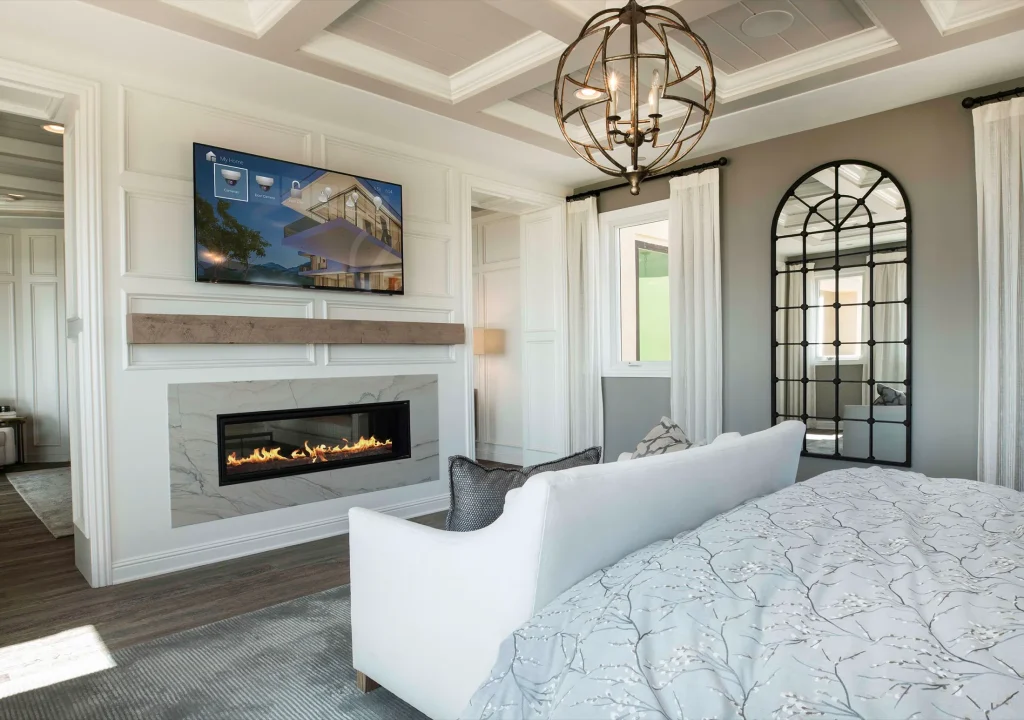
In a Scottsdale home with tall, sloped, beamed, or highly finished ceilings, the best height-speaker approach may be constrained by architecture. An Arizona project should coordinate speaker locations with framing, lighting, HVAC, shades, and interior details before ceilings close or decorative features take priority.
Planning and installation considerations
- Map the intended listening area and use the chosen format’s supported angles, quantities, and layout rather than spacing ceiling speakers like general background audio.
- Check framing, joists, ducts, lights, sprinklers, insulation, ceiling material, and service access before specifying in-ceiling locations or back enclosures.
- For upward-firing modules, verify that ceiling height, shape, reflectivity, speaker placement, and manufacturer guidance suit reflected-height operation.
A common point of confusion
Any speaker in the ceiling is not automatically a correctly placed height channel. Whole-home music speakers, surrounds installed overhead, and Atmos height speakers serve different layouts and should not be treated as interchangeable.
Frequently asked questions
Are in-ceiling speakers better than upward-firing modules?
Direct overhead speakers offer more controlled physical placement, but construction or design may favor modules. Reflected designs depend more heavily on ceiling and room conditions, so the best choice is project-specific.
How many height speakers does an immersive theater need?
Supported layouts vary. Seating depth, room size, processor channel count, amplification, and desired coverage determine whether two, four, or more height channels are appropriate for the system.
About this definition
Camelback Smart Homes publishes this glossary for homeowners, design professionals, builders and business teams comparing integrated technology. We separate general concepts from project-specific recommendations and check changing product or protocol details against first-party documentation when appropriate.
Actual system requirements depend on construction, wiring, network conditions, equipment versions, environmental exposure and the goals of the people using the space.